
Sarah Winman
Fiction 2017 | 462 pages

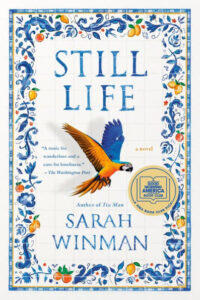
We begin during WWII, 1944, on the battlegrounds of Tuscany. As allied troops advance and bombs fall around deserted villages, a young English soldier, Ulysses Temper, finds himself in the wine cellar of a deserted villa. He has a chance encounter with Evelyn Skinner, a middle-aged art historian, 40 years his senior, who has come to Italy to salvage paintings from the ruins. Ulysses and Evelyn form a kindred bond amongst the rubble of war-torn Italy and set off on a course of events that will shape Ulysses' life for the next four decades.
After the war, and the death of a soldier who is very important to him, Ulysses returns to London. But his time in Tuscany remains in his heart. When an unexpected inheritance brings him back to where it all began, Ulysses knows better than to tempt fate, and returns to the Tuscan hills. Perhaps it helps that I have been to Florence, but Winman's descriptions of the next four decades in my favorite Italian town are vivid. I can see the town and feel the culture. Once Ulysses and entourage leave London for Florence, reading Still Life is like a soft warm blanket thrown over my shoulders. I guess the London time was necessary for context, but it doesn't compare to time in Firenze.
With beautiful prose, extraordinary tenderness, and bursts of humor, Still Life is a portrait of unforgettable individuals who come together to make a life. Ulysses gathers Col, Cressy, Pete, his former wife Peg (at times), and his adopted daughter Alys, and eventually, years later, Evelyn, into an intentional family. And, of course, I cannot forget the blue parrot Claude. This family has more respect, love, and caring than many families. It is a joy to experience vicariously.
An example of Winman's writing from page 128. "They'd traveled more than a thousand miles, had eaten twenty plates of spaghetti, nine stews, seventeen baguettes, a crop of apricots and a wheel of cheese. They had drunk forty coffees and eight bottles of wine and seven beers and two brandies." Instead of her describing the 1000-mile journey with roads traveled and villages encountered, she makes it real and tangible and visceral. This is her gift as a writer.
She also uses her writer's prerogative for an unusual display of style. She employs no quotation marks (and thus uses the word "said" ad nauseam). Now supposedly this technique creates more intimacy between the reader and the characters, heightens emotion, reduces distance, and is fluid. I can't say if credit goes to this stylistic choice or not, but I felt intimately connected with the characters in Still Life. I came to know and understand them well. It takes a bit to get used to this way of writing ... and some reviewers never do. But I felt comfortable with it after a while.
The one disappointment I have is that we did not return at the end of the book to the opening pages. I am wondering still today how many paintings Evelyn and her life-long friend Dotty actually found and saved.
This is our current book club read. I highly recommend it as a novel to immerse yourself in. It is particularly good as a winter read, because it made me want to build a fire in the wood stove and cozy up to it with my book.
January 2026