
Ian McEwan
Fiction 2025 | 303 pages

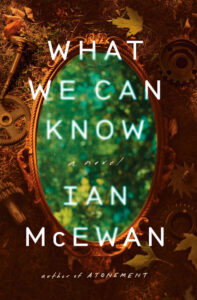
The year is 2119. Tom Metcalfe is searching for a poem written in 2014 by the famous Francis Blundy. There exists only one copy of the corona poem, a birthday gift and tribute to his wife Vivien. At a small birthday party in which Francis reads the poem to Vivien, she takes the one copy, rolls it up ... and does what with it? Our protagonist, perhaps an important historian, perhaps just someone who is obsessed, is searching for it. He studies journals and e-mails of Vivien, Francis, and their friends, especially those who attend the “Second Immortal Dinner,” during which Francis reads his corona for Vivien.
Slow and a bit boring, I decide to stay with this slightly dystopian novel. I was disappointed that McEwan didn’t insert more visceral descriptions of the decline of the human race. It is the background, the context, but not very vivid. However, there is something about it that speaks to me. It promises a surprise. Not to mention the irony that I am at a writing workshop and we are learning to craft poetry. Much has happened in the period Tom studies, 1990-2030. We pay no real attention to profound climate change, tension between countries, nuclear capability, authoritarianism, and the decline of civilization. An apt read for these current days. And the results in this novel are a crisis of dystopian proportions.
And then, just over half way, we meet Part Two. Part Two is an entirely different book. No more bouncing back and forth between 2119 and 2014. We are now firmly ensconced in 2014, and we are about to hear Vivien’s story of what really happened with her first husband Percy and her second husband Francis.
Suddenly it is a page turner. I am balancing this book in the midst of a travel crisis. Our flight from Cabo (where I had just spent eight days in a writing workshop in Todos Santos) was cancelled. Abruptly, all of us on flight 2423 are catapulted into the arms of dazed Alaska Airline employees who are befuddled, confused, and anxious. “What do we do with these hordes of people who need to collect their luggage (because we are still in Mexico and have not yet cleared customs) and every single one of them are seeking new flights?” They shepherd us quite well I think. My companion Leslie calls Alaska while we are standing in some line. (Good thing I checked with my phone carrier before I left to make sure I could make phone calls in Mexico. Um, not.) She discovers that they rebooked her on a flight the next day. Then she asks about me, and discovers I am booked on a flight through Seattle in 58 minutes. I quickly say goodbye to Leslie, run up the escalator with my luggage, cut into line, and deposit my bag again for its trip to Redmond after convincing the agent that I really DID have a seat on the “completely full” flight. I run to the gate and board, only to find that it seems I am sharing seat 3A with another woman. All that sorted out, I eagerly open my page turner to finish that last 80 pages.
Though you may struggle a bit with the first half (or maybe not) it is worth sticking with What We Can Know. But Part Two clearly engages my literary senses. I recommend it.
The is a book to be read later in the year by the book club of the very same Leslie and my other friend René. Thank you for the suggestion.
p.s. A corona (or "crown of sonnets") is a demanding poetic form comprising seven linked sonnets of 14 lines each that explore a single theme. The final line of each sonnet becomes the first line of the next sonnet, and the final line of the last sonnet repeats the opening line of the first, creating a continuous circular structure.
February 2026