Author Archives: Andrea Sigetich

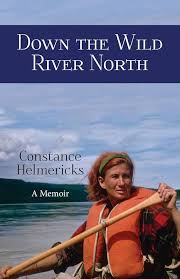
Down the Wild River North

Constance Helmericks

Memoir 1969/ 303 pages

I kept thinking it was coming, but when I turned to page 124 and started chapter 8, all the air left me and I collapsed like a spent balloon and realized I could not go on.  I SO wanted to like this book, recommended by a friend.  The author talks extensively about the geography, the river, their camps, all the mud from big floods, people they meet along the way.  This is a memoir.  The author, Constance Hemericks, took her daughters, Ann (12) and Jean (14) up the Peace River to the Arctic Ocean and the North Pole (yes, the Peace River flows north) in summer, 1964.  Such an adventure!

However I ended my journey because ALL she writes about is the geography and writes very little about the three women.  I don't read about their personalities, their emotions.  I wanted to know what happened when the hair curlers floated to the top of the canoe.  I wanted to know about their periods and if they synced.  I wanted to know how they dealt with trash.  I wanted to know what was in the mail when they received a bundle.   I wanted to know how Constance dealt with loosing her shoe in the mud and if she really wet barefoot. Or what they ate for breakfast.  Or how they bear-proofed their food stash.  Or any teenage angst.  These sort of daily acts of living were not included in the writing.  How disappointing!  For me, she misses a very important part of the story.  In some ways, the essence of her memoir.

Unfortunately, I do not recommend Down the Wild River North.

And so I am moving on to whatever is next on my shelf.

July 2026

A Cold Day in Paradise

Steve Hamilton

Fiction 1998/ 277 pages

three-hearts

I was searching around for a mystery series … at least to read a few.  Two of my friends suggested Steve Hamilton, and the first book in his series is A Cold Day in Paradise.   The setting was very appealing to, as I was born and raised in Detroit.  But the setting alone would not have made it a good read.  It needed some good authorship, too, and this book was a page turner!  I am definitely going on to the second book in the series.

Alex McKnight was a cop in Detroit when he was shot three times, and his partner was killed.  Alex still carries a bullet in his body, too close to his heart to be removed.  That was 14 years ago.  Since then, Alex has taken his 3/4 disability pay and moved to Paradise to be a private investigator.  Paradise is a small town on the shore of Lake Superior, in Michigan’s Upper Peninsula.

So how is it that Maximillian Rose, who is still in prison for his crimes against McKnight and his partner, had decided now is the time to seek revenge? We really don’t know how the timing came about, but clearly the effort was being put forth, with a couple of seemingly unrelated murders as the non-Rose perpetrator gets closer to McKnight.  Actually, I thought the explanation of the conclusion was a bit unclear.  At least it was to me.

My major issue with Hamilton’s work is his total lack of women characters.  The only one with any part to play at all in the novel was Sylvia, the woman Alex has/had an affair with.  I don’t know if Hamilton is sexist and doesn’t think a cop or a technician can be a woman, or if he just has no capacity to develop and write women characters.  That will be my litmus test in the second book of his that I read.

Yes, I recommend A Cold Day in Paradise for its pure fun as a mystery.

July 2026

The Little Prince

Antoine de Saint-Exupery

Fiction 1943/ 83 pages

three-hearts

Someone in my online book group suggested rereading The Little Prince as an adult.  So I did, this morning.  It was sweet.  I received no important adult message, It was just fun to read the story again.

June 2026

Ishmael

Daniel Quinn

Fiction 1992/ 383 pages

three-hearts

This is the 25th anniversary of the book Ishmael, Daniel Quinn’s 1992 philosophical novel.  I decided to read it, never having done so before.  It is a Socratic dialogue between an unnamed narrator, the pupil, and a highly intelligent, telepathic captive gorilla named Ishmael, the teacher.

The book critiques modern civilization, arguing that humanity's belief in its own supremacy and destiny is a cultural myth driving the planet toward ecological catastrophe. 

The book is structured around a few foundational concepts:  

Takers vs. Leavers: Ishmael divides human culture into two distinct groups.  Takers represent modern, industrialized civilization. They believe humans are the pinnacle of creation, own the world, and are destined to conquer and control it — a worldview born from the Agricultural Revolution.  Leavers represent indigenous, tribal cultures. They live within the limits of the natural ecosystem, viewing themselves as part of the community of life rather than its masters.

The Mother Culture:  Ishmael challenges his pupils to recognize the stories and assumptions that modern society blindly accepts, creating our cultures.

The Law of Life: Ishmael argues that humans, like all other species, are bound by natural laws. The core rule is simple: you may compete for resources, but you cannot wipe out your competitors or destroy the environment that sustains you. By attempting to "exempt" ourselves from this law, Taker culture has made itself captive to a destructive system.

A philosophical book, yes, but it also has spiritual undertones as well as direct addressing of mythology, ecosystems, sustainability, the importance of diversity, the purpose of humanity,  and the role of the human on the planet.

I found it quite intriguing, but not all of you will.  Aside from the journey that is a human talking with and learning from a gorilla, it reads more like a nonfiction book than fiction.  It does, however, make you think.  I recommend only with a grain of salt ... you must be in the right, receptive mind space to enjoy this book.

"With man gone, will there be hope for gorilla?"

June 2026

Raven Black

Ann Cleeves

Fiction 2006/ 386 pages

three-hearts

We were at Beverly Beach State Park and there was a woman sitting in one square foot of sunlight at the end of her campsite, partially on the camp road, reading.  She had one square foot more sun than we had at our campsite, which was 100% completely covered with tree canopy.  I stopped and spoke with her on my way to the beach, and then again on the way back.  She was reading a book by Ann Cleeves.  Turns out the first book in the series she was reading was Raven Black. I decided to check her out.

The book was kinda fun, but the primary character, Inspector Jimmy Perez, did nothing for me.  No real defining personality traits.  He is not Armand Gamache (Louise Penny).  I don't think I will read any more of her.  I am looking for another mystery series now.  Not Louise Penny nor Robert Parker nor Patricia Cornwall nor Nevada Barr nor Dan Brown nor John Grisham. Looking for something set in the US or Canada.  Do you have a suggestion?

June 2026

Flesh

David Szalay

Fiction 2025 | 368 pages

two-hearts

This book has a lot of sex in it but not love. 

Flesh follows the life of its protagonist, István, from his difficult adolescence in post-communist Hungary to his rise and fall in the elite circles of London. The story traces István’s journey as he navigates a world where his capacity for violence becomes his primary asset — first as a soldier in Iraq, then as a bodyguard and driver for the super-rich, and finally as a wealthy property developer. A sweeping, decades-spanning novel, István eventually returns to his hometown in Hungary.

80% of the words that come out of his mouth are, quite literally, "okay."  He says "okay" to proposals, to ideas, to suggestions, to sex, and as a constant response to "how are you?"  He has no color, no personality, no insight, no depth, no self-awareness.  He must be the most boring character I have ever encountered.

The story didn't make a lot of sense to me.  István, after his stints in detention and the army, works as a bouncer, a bodyguard, and a driver.  Then, suddenly, a few years pass and he is married, has a son, is somewhat articulate, and has become a successful business property developer.  I do not know how he went from menial, physical jobs to this professional role.  Even after rereading it.

I also cannot wrap my head around why Marian recommended this book for book club. It doesn't seem like something we would like, and, more important, I cannot imagine Marian reading Flesh and liking it.

I don't like the character, the story line is confusing, and nothing has grabbed my attention.  I do not recommend Flesh.

June 2026

The Fountains of Silence

Ruta Sepetys

Historical Fiction 2019 | 499 pages

four-hearts

Josie, I don’t know how you do it.  You always unearth not-well-known long books from a few years ago, and they are always stellar, such as this one, The Fountains of Silence by Ruta Sepetys.

This is a sweeping, beautifully written historical novel about a time in history you may not know much about, 40 years, beginning in 1939, of leadership under Generalisimo Francisco Franco in Spain.  Franco was an oppressive, authoritarian leader, a dictator, a fascist, a cruel leader who cared more about himself than his people.  The Fountains of Silence is about what Franco does to attract US investment, hoping to fund his government.  He turns old buildings into beautiful structures, and encourages complete support for the oil tycoons, journalists, professors, financial managers and others who want to explore how Spain can serve their business development.

Our main character is Daniel Matheson, who is visiting Madrid with his oil business owner father and Dallas, Texas socialite mother, for much of the summer of 1957.  Ana is a worker in the hotel, who must obey rules the management insists upon, such as not talking shout their own personal lives, and never being with a resident unless fulfilling a specific request.   Daniel falls in love with Ana Torres Moreno,  but that definitely breaks all the rules.

We follow their relationship as Ana shows Daniel some of the wonders of Madrid.  He also becomes friends with her sister Julia and brother Rafa, and Julia’s baby.  There are interesting sub-plots.  These criss-crossing threads keep me engaged in the book.  It is an easy read.  Took me just over two days. 

A major sub-plot is that Daniel’s father wants Daniel to assume leadership of his oil business in Dallas but Daniel wants to be a photojournalist.  He meets Ben, who works at a major magazine and encourages and mentors Daniel in his photojournalist efforts.

And there is Fuga, who wants to crawl his way out of poverty by becoming a bullfighter.

And why are there empty caskets in the pile of infant coffins that came from the orphanage Insula, who specializes in the adoption of young children.?

And who is sending Ana threatening notes and, for heaven’s sake, why?

I really enjoyed Fountains of Silence,  I learned a great deal about Spain, and also explored family dynamics, love, mystery, resistance to social change, career decisions, cultural clashes on minor issues, such as what shoes are important to wear to a particular event, the role of adoption during a post civil war occurrence, and hidden truths.  My most important learning is the one the author seemed to want for us … to explore the silences we all keep; the value of silence; the debilitating aspects of silence; the release of silence; the necessity of being silent no more.

I completely recommend The Fountains of Silence.

June 2026

The White Hot

Quiara Alegria Hudes

Fiction 2025 | 176 pages

two-hearts

The White Hot is a bizarre, absurd novel (novella?). How did it make its way to my To Be Read list? Did one of you suggest it?

April!, 26. leaves her daughter Noelle on Noelle's 18th birthday, for ten days.  She takes a bus from Philadelphia to Pittsburgh, carrying not a thing with her.  April spends four days and nights in Ohiopyle State Park, and then meets a man named Kamal.  Kamel takes her to his home, which has no furniture, and introduces her to Charles Mangus.   Do you know Mangus?  He died in 1979 and bears the moniker "The angriest jazz musician of all time."  I played some of his music.  It is nothing short of angry, depressing, and defeating.  She spends a few days with him, basically wrecking his few belongings, and soon returns home again.  She had gone in search of the white hot spot .... the part of her that is overflowing with anger, regret, explosiveness, failure, and pain.  I think she heals this spot somewhat.

It is an outrageous, odd, depressing novel. I definitely un-recommend it.

June 2026

March

Geraldine Brooks

Fiction 2005/ 280 pages

three-hearts

I don’t know, I just couldn’t quite enjoy this book.  The plot is wonderfully inventive.  This is the story of March, who is the father of Louisa May Alcott’s four little women, Meg, Jo, Amy, and Beth.  The storyline takes place in two venues/timelines, one when March is 39 and leaves his young women and his wife Marmee at home in Concord, Massachusetts.  He signs up for the Civil War as an idealist, a vegetarian, an abolitionist, an anti-slavery and pro-freedom revolutionary, and a chaplain.  The other story is about 20 years earlier when he meets and marries Marmee and begins to have daughters.  It is perhaps the plot itself, as creative as it is, that sours the book for me. Having read Little Women decades ago, I love the chapters where March is home with his family.

I find the chapters that tell the story of the Civil War to be boring, horror filled, brutal, barbaric, grim, sad, powerful, and violent, coupled with March’s debilitating inability to be a chaplain neither he nor his charges can be proud of.  Though, when he begins to teach young black children their letters, he finds his purpose and comes into his own.

Brooks is, of course, a magnificent writer.  Perhaps I am simply done with stories about past wars, at least for a while.

I can recommend this book to lovers of Geraldine Brooks.  It is another one of her many masterpieces. Enjoy March.  If you read it and love it, I would be pleased to read your review of it.

June 2026

How to Read a Book

Monica Wood

Fiction 2024/ 280 pages

three-hearts

How to Read a Book started out with interesting characters and plot.  We have three major characters. Violet, our narrator, is 22 and was just released from prison, where she served about 1.5 years for driving drunk and killing a woman who was driving in the opposite direction.  Harriet is the volunteer who led a Book Club in the women's prison, two hours a week, for women who were interested in reading together, including Violet.  Violet happens upon Harriet in “the Outs” when she begins to live again in the real world in Portland, Maine.  Frank is a handyman who does odd jobs for Harriet, and is the husband of Lorraine, the woman who was killed by Violet.

While Wood develops each of these characters well, she does not quite take advantage of the relationships they could have together.  Especially, she does not develop Violet and Frank's relationship very well.  This is a missed opportunity, I believe.

Yet, the first two-thirds of the story is engaging, especially when Violet takes a job working with three African grey parrots.

I'm the last third, everyone turns romantic and falls in love with someone or another.  I found this rather irritating ... like a romance novel plopped itself into the novel.

But the end comes around and redeems the novel.

It is a fun, light read, especially given the topic.  You may enjoy it, or you may not. I would not suggest you urgently run out and buy it.

June 2026