Category Archives: Uncategorized

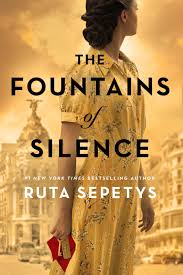
The Fountains of Silence

Ruta Sepetys

Historical Fiction 2019 | 499 pages

four-hearts

Josie, I don’t know how you do it.  You always unearth not-well-known long books from a few years ago, and they are always stellar, such as this one, The Fountains of Silence by Ruta Sepetys.

This is a sweeping, beautifully written historical novel about a time in history you may not know much about, 40 years, beginning in 1939, of leadership under Generalisimo Francisco Franco in Spain.  Franco was an oppressive, authoritarian leader, a dictator, a fascist, a cruel leader who cared more about himself than his people.  The Fountains of Silence is about what Franco does to attract US investment, hoping to fund his government.  He turns old buildings into beautiful structures, and encourages complete support for the oil tycoons, journalists, professors, financial managers and others who want to explore how Spain can serve their business development.

Our main character is Daniel Matheson, who is visiting Madrid with his oil business owner father and Dallas, Texas socialite mother, for much of the summer of 1957.  Ana is a worker in the hotel, who must obey rules the management insists upon, such as not talking shout their own personal lives, and never being with a resident unless fulfilling a specific request.   Daniel falls in love with Ana Torres Moreno,  but that definitely breaks all the rules.

We follow their relationship as Ana shows Daniel some of the wonders of Madrid.  He also becomes friends with her sister Julia and brother Rafa, and Julia’s baby.  There are interesting sub-plots.  These criss-crossing threads keep me engaged in the book.  It is an easy read.  Took me just over two days. 

A major sub-plot is that Daniel’s father wants Daniel to assume leadership of his oil business in Dallas but Daniel wants to be a photojournalist.  He meets Ben, who works at a major magazine and encourages and mentors Daniel in his photojournalist efforts.

And there is Fuga, who wants to crawl his way out of poverty by becoming a bullfighter.

And why are there empty caskets in the pile of infant coffins that came from the orphanage Insula, who specializes in the adoption of young children.?

And who is sending Ana threatening notes and, for heaven’s sake, why?

I really enjoyed Fountains of Silence,  I learned a great deal about Spain, and also explored family dynamics, love, mystery, resistance to social change, career decisions, cultural clashes on minor issues, such as what shoes are important to wear to a particular event, the role of adoption during a post civil war occurrence, and hidden truths.  My most important learning is the one the author seemed to want for us … to explore the silences we all keep; the value of silence; the debilitating aspects of silence; the release of silence; the necessity of being silent no more.

I completely recommend The Fountains of Silence.

June 2026

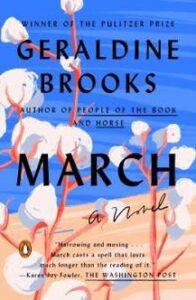
March

Geraldine Brooks

Fiction 2005/ 280 pages

three-hearts

I don’t know, I just couldn’t quite enjoy this book.  The plot is wonderfully inventive.  This is the story of March, who is the father of Louisa May Alcott’s four little women, Meg, Jo, Amy, and Beth.  The storyline takes place in two venues/timelines, one when March is 39 and leaves his young women and his wife Marmee at home in Concord, Massachusetts.  He signs up for the Civil War as an idealist, a vegetarian, an abolitionist, an anti-slavery and pro-freedom revolutionary, and a chaplain.  The other story is about 20 years earlier when he meets and marries Marmee and begins to have daughters.  It is perhaps the plot itself, as creative as it is, that sours the book for me. Having read Little Women decades ago, I love the chapters where March is home with his family.

I find the chapters that tell the story of the Civil War to be boring, horror filled, brutal, barbaric, grim, sad, powerful, and violent, coupled with March’s debilitating inability to be a chaplain neither he nor his charges can be proud of.  Though, when he begins to teach young black children their letters, he finds his purpose and comes into his own.

Brooks is, of course, a magnificent writer.  Perhaps I am simply done with stories about past wars, at least for a while.

I can recommend this book to lovers of Geraldine Brooks.  It is another one of her many masterpieces. Enjoy March.  If you read it and love it, I would be pleased to read your review of it.

June 2026

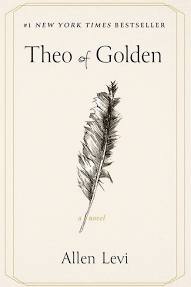
Theo of Golden

Allen Levi

Fiction 2023 | 387 pages

two-hearts

I belong to a Facebook group, Book Club Favorites.  (Unfollowed two other groups.  Book readers are extremely prolific!

Anyway, over the last few months, Theo of Golden received an unbelievable number of posts and incited a plethora of discussion.

"You must read this book.  I loved it!”

"I fell asleep reading it.  Boring."

"An inspirational book about kindness."

"Too spiritual."

'I don't need a feel-good book to tell me to be kind."

"Might be my favorite book of all time."

"Way over-hyped."

"Loosely disguised Jesus figure."

I was curious to see where I would land.  There was very little middle ground. Readers loved it or hated it.

Virtually everyone wrote about the story, and no one wrote about the writing.  I will change that direction with my review.

Theo is a well-traveled, wealthy man of 86 who decides to move south from New York City for a year or so.  He moves to Golden, Georgia, and meets and befriends many people in this small Southern town.  On one of his first days, he enters The Chalice ... a coffee shop that makes European coffee just the way he likes it.  On the walls of The Chalice are 92 penciled and pen&ink portraits, created by a local artist.  We learn about how Theo buys each portrait, one at a time, and gives it to the person in the portrait, nearly always inspiring deep conversation. Theo is generous, kind, compassionate, and a superb listener.

That is the story line, and it is an interesting one. 

Unfortunately, I felt the writing was awful.  I don't know if Allen Levi did this on purpose, but it wrecked the book for me.  The character of Theo is one-dimensional, tracing paper thin in character development, sophomoric, shallow.  There is no depth, no texture, no nuance in his personality.  Much as I love debut novels, I will not be looking forward to his second book.

And the ending is contrived, all too convenient. Writing a letter to close up all the loose ends the author didn’t manage to do in the plot line is also a sign of an unsophisticated author.

I cannot think of a single person I would recommend read Theo of Golden. Therefore, by definition, this book receives two hearts.

June 2026

Many Books

Andrea Sigetich

Many genres | Thousands of pages

four-hearts

It has been ten years today since I started my blog, Dusty Shelves.  Hard to believe!  I still enjoy writing it and hope you still enjoy reading it too, at least once in a while.  First book I blogged on was Dead Wake by Erik Larson.  It received four hearts. Here is what the hearts mean.

four-heartsLike it a lot or loved it; I recommend it; put it on your list!

three-heartsLike it; I recommend, with some reservations.

two-heartsI don’t recommend it, though it was compelling enough for me to finish reading.

one-heartI couldn’t get through it

May 2026

The Unlikely Pilgrimage of Harold Fry

Rachel Joyce| Fiction

2015, 384 pages

Made it half-way through.  I found The Unlikely Pilgrimage of Harold Fry to be Insipid, implausible, simple, contrived.

Harold sits at breakfast one day with his wife and opens a letter from a long-ago colleague, Queenie Hennessy.  Queenie tells him she is in hospice in Berwick-upon-Tweed, which is some 600 miles north of him, and is dying of cancer.  He believes he likely has some unfinished business with Queenie.  He writes her a short note and goes to the post to send it to her.  But he walks past the first postal box and keeps going, past the second and third.  By the afternoon he has decided that Queenie will only stay alive as long as he keeps walking forwards her.  And so he does.  

What I find implausible is that by the evening, when he calls home, his wife Maureen knows that he is five miles north.  What wife would not throw a small pack in the car with e few clothes, a pair of shoes, his cell phone, and maybe some snacks, and take it to her husband?  Even if their relationship has seen better days?

What I find both insipid and simple is that he meets people who allegedly give him insight.  But what he hears is not insightful.  Only platitudes, and words that remind him of his past.

The story is contrived … forced, artificial … only the fantasy of the author with no real story.  And Harold Fry has no emotional pallet, no depth.

And so I am moving on to whatever is next on my shelf.

May 2026

Heartwood

Amity Gaige

Fiction 2025 | 325 pages

four-hearts

The pink bandana.  A small item, that plays a large part.  I was surprised at the climax.  I did not quite see the situation resolving the way it did ...

Valerie Gillis is a 42-year-old woman, her trail name is Sparrow, who becomes lost near the northern terminus of the Appalachian Trail, while hiking the AT.  She is not a highly competent outdoors woman.  She doesn't know how to start a fire with the six matches she has.  And yet Lieutenant Bev Miller, one of Maine's few women game wardens, leads her teams of hundreds and hundreds of searchers in the Maine woods, searching for Valerie.

As with Sea Wife by the same author, just a few blog posts ago, Gaige creates strong and nuanced characters.  We learn much about the personalities, motivations, and inspirations of both Valerie and Bev.  There are other supporting characters, including Valerie’s partner, her parents, other hikers who are interviewed, and some of the searchers.  But I think my favorite of the supporting characters is Lena, and older woman in a wheel chair who lives in an assisted living community and gets the idea that she knows something about the case of the missing Ms. Gillis.  She is quirky, brilliant, delightful.

We follow the journey over many days (I won’t say how many; that wood be a spoiler!) until a resolution is reached.  The resolution is satisfying and fills the gaps.  In the meantime, we also learn about the unique fortitude and quirkiness of Mainers.

No question, read this book, especially if you like the woods, and enjoy good writing!

May 2026


Buckeye

Patrick Ryan

Fiction 2025 | 464 pages

four-hearts

Cal and Becky Jenkins and Felix and Margaret Salt, along with their sons Skip and Tom, tell a profound story from the 1940s through the late 20th century.  Richly written, with extraordinary character development, we follow these families against a backdrop of WWII and the Vietnam War.  Home is the small town of Bonhomie Ohio.  

There are themes of love loss, abandonment, death, grief, happiness, friendship, betrayal, loyalty.  An affair between Cal Jenkins and Margaret Salt during WWII binds their families together with consequences that unfold over decades.  The characters are complex and multi-dimensional.  Take for example Cal, who is unable to serve in the war due to a disability, and his wife Becky, who is a seer who can communicate with the dead.  Felix enlists in the Navy and really has no idea what to do with his attraction to men, and not to his wife.  Margaret doesn’t ever warm up to motherhood and eventually abandons them all, adding greater complexity to the interpersonal relationships.

Someone described this book as slow-paced.  I don’t think that is true, though I did find myself wanting to savor it, rather than rush through.

I recommend Buckeye, no hesitation!

April 2026

Girl Waits with Gun

Amy Stewart

Historical Fiction 2015/ 405 pages

three-hearts

The year is 1914. The location, New Jersey.  A newfangled automobile crashes into a horse-drawn carriage bearing the three Kopp sisters, Constance, Norma, and Fleurette.

Henry Kaufman, a silk factory owner with a fearsome reputation was drunk and driving a fancy automobile.   Henry gives the sisters his address, with a promise to pay for the damages, but he never forks over the cash.  And then a series of threats, harassing letters, intimidation, ransacking of their home, and gunshots occur.  Being true to themselves, the Kopp sisters aren’t intimidated by him. They don't back away from bringing Kaufman to justice.

The sisters' situation is unusual in 1914. The three of them live together in an old farm home, out in the country.  Usually such circumstances, without a father or mother, causes young women to move in with a male relative.  And their brother Francis keeps trying to make that happen.

Amy Stewart is quite adept at character development. We get to know Constance who, the tallest woman in any room, knows her mind, is very responsible for her younger sisters, has strong values, never fears fighting for what is right. She is brave, adventurous, and sharply intuitive.

Fleurette, the youngest of the three at 16, is playful, creative, idealistic.  She wants to live life in all its fullness.

Norma is the least developed.  We don't know much about her, except that she is an excellent farmer, great with animals and is completely willing to back-up Constance.

And then there is Sheriff Heath. He is fine, loveable character.  I believe we will see a lot of him in the next books.

This is the first book in a series of five.  Though the writing and story were excellent, I found the execution somewhat tedious.  I have had a sip of the Koop sisters; I think I am satisfied for now..  Read this if the story tickles your fancy.  You won't be disappointed.  Much of the book is historically accurate.

April 2026

The Tree Collectors (Tales of Arboreal Obsession)

Any Stewart

Nonfiction 2024 | 301 pages

four-hearts

This is a breathtaking book!  Amy Stewart discovered a community of tree collectors.  These are people who, typically, select a tree, say maples, or a characteristic, say tropical trees, or a mission, say, to beautify neighborhoods that have no trees, and collect every species they can, rare and common, and plant, nurture, and grow them on their land, or in pots.  She interviewed and visited 50 such collectors throughout the world (the number of countries represented in her sample is amazing). 

I present you with three of the tree collectors.  Januez Radecki is a Polish arboreal therapist who encourages the residents of the elder care home where he works to plant, prune, weed and water trees, prodding them with purpose, mission, fresh air, and exercise.  Joe Hamilton cultivates pines on land passed down to him from his great-grandfather, once a slave, saving the trees and history for future generations. Reagan Wytsalucy is replanting peach trees in the Canyon de Chelly region of Arizona.  Many died during the 1864 Long Walk when the US Army forced Navajo off their lands in New Mexico and Arizona.  Peach orchards, a source of food and trade among the Navajo people, were intentionally destroyed after the Long Walk to starve any Navajo who survived. Reagan’s work introduces culture, truth, and history to her Native communities.

You will learn about a subject you likely did not know much about and did not know what you did not know.  Her three pages on each tree collector are all fascinating, educational, and interesting.

I stopped buying books about a dozen years ago, unless there is something I need and cannot find at my library.  If you are still buying books, this (hardcover) should be in your shopping cart, because the additional bonus is the author is also a watercolor artist, and her paintings are on about two out of every three pages.  Her portraits of the tree collectors themselves communicate their sense of adventure, learning, uniqueness, and passion.

I highly recommend this book. Mary, you always give me good ideas of books to read, but this suggestion is extraordinary!  I thank you, my long-time friend.

February 2026

Guilty by Definition

Susie Dent

Fiction 2025 | 360 pages

four-hearts

"Ipsedixitism refers to making a dogmatic assertion or statement without proof, relying solely on one's own authority.". This word seems very apt in our political climate these days.

This is one of probably 70 words I was introduced to reading Guilty by Definition.  If you love words .... are a logophile ... you just may enjoy this page turner as much as I did.  If you like some mystery sprinkled in with your love of words, request this book at your library right now because there was a long wait at my library .

Martha is a supervisor who works at the Clarendon English Dictionary in Oxford, researching the derivation and evolving meaning of words.  The Clarendon's purpose is to create a concise yet complete dictionary for school, home, and business use, focusing on standard, common-use English. 

Martha and her staff of Safi, Alex, and Simon, receive a cryptic letter one day, replete with seemingly vague references and numerous Shakespeare quotes. Then they each receive a postcard with a simple Shakespeare quote at their homes.  It immediately becomes clear to them that the author of these communications, who calls himself/herself Chorus, is making reference and perhaps giving clues to the disappearance of Martha's older sister Charlie more than ten years ago.  We follow them as they attempt to unravel the mystery, all the while playing with obscure words.  

Dent, in her debut novel, serves up two mysteries — the fate of Charlie and the identity of Chorus.  As Chorus sends more letters and postcards and throws more challenges, Dent invites us to play along and decipher the tricky word games. We eagerly follow Martha and her staff as their work takes them out of their offices and into their most intriguing sleuthing yet.

The one challenge I had is each chapter begins with a not-well-known word and its simplest definition.  I couldn't help but go back to the beginning of each chapter after I finished reading it, to hypothesize why the author Susie Dent chose this word for this chapter.

I completely enjoyed this book; it took but a mere weekend to read.  Yes, if you love words or mysteries, or simply the written word, I will venture you will enjoy it also.

January 2026